




Hot Games








Live Cards










Popular Games











Creating a Secure Fairplay Login
A login is created once and attacked indefinitely, so the creation deserves the care. The sequence for a new account — whatever search brought you, from plain Fairplay login to sign up my fairplay login:
- Open the official site by typing the address or using a bookmark you made earlier
- Choose registration and anchor the account to your phone number — the OTP-first standard for India — or to an email you actually monitor
- Pick the fairplay login id the account will answer to
- Generate a password no other service has seen: twelve-plus characters, mixed, straight into a password manager
- Confirm the OTP from SMS or the link from email, and the account exists
Where future problems are born: a SIM that might leave your control makes OTP and recovery hostage to luck; a reused password makes this account exactly as safe as the least safe site sharing it; details that diverge from your documents turn an eventual verification into a dispute. None of these costs anything to get right at minute one. The login id itself can be ordinary — it is the public half of the pair, and all the secrecy lives in the password and the phone behind it.
Managing Account Settings
The security settings repay a visit immediately after registration and a glance every month after. The audit, in order:
| Item | What to confirm | Rhythm |
| Phone and email | Both current and reachable — they are the recovery lifelines | Monthly |
| Password | Unique beyond doubt; change on any suspicion | On doubt, immediately |
| OTP and alerts | Which actions trigger codes, which alerts announce logins | Once, then after changes |
| Session list | Reviewed and cleaned — detailed in its own section below | Monthly |
Common Fairplay Login Problems and Solutions
Access failures repeat the same handful of patterns, and each has a working sequence:
| Problem | Step one | Step two | Step three |
| Password rejected | Retype slowly, watching case and layout | Paste from the password manager | Run recovery rather than guessing on |
| OTP never arrives | Wait two minutes, check signal and DND mode | Request a single fresh code | Verify the number on the account is right |
| OTP rejected | Check the code against the newest SMS | Request again and enter within the window | Sync the phone’s clock, then retry |
| Account temporarily locked | Stop attempting — each failure extends it | Use the recovery option after the pause | Contact official support with account details |
| Page or form malfunctioning | Hard-refresh, clear cache | Try a private window or second browser | Update the app, or switch app and browser |
| Session drops repeatedly | Allow cookies for the site | Whitelist the site in cleaner apps | Check the clock and date settings |
Above every row sits one rule: a login problem is never solved by finding “another site that works”. The brand answers to several names — fairplay 24 login, fairplay pro login, my fairplay among them — and clone-builders farm precisely that confusion. Failed access gets fixed inside the official page or through recovery; it never gets fixed by typing the same credentials into the next address a search suggests.
Recovering Your Fairplay Account
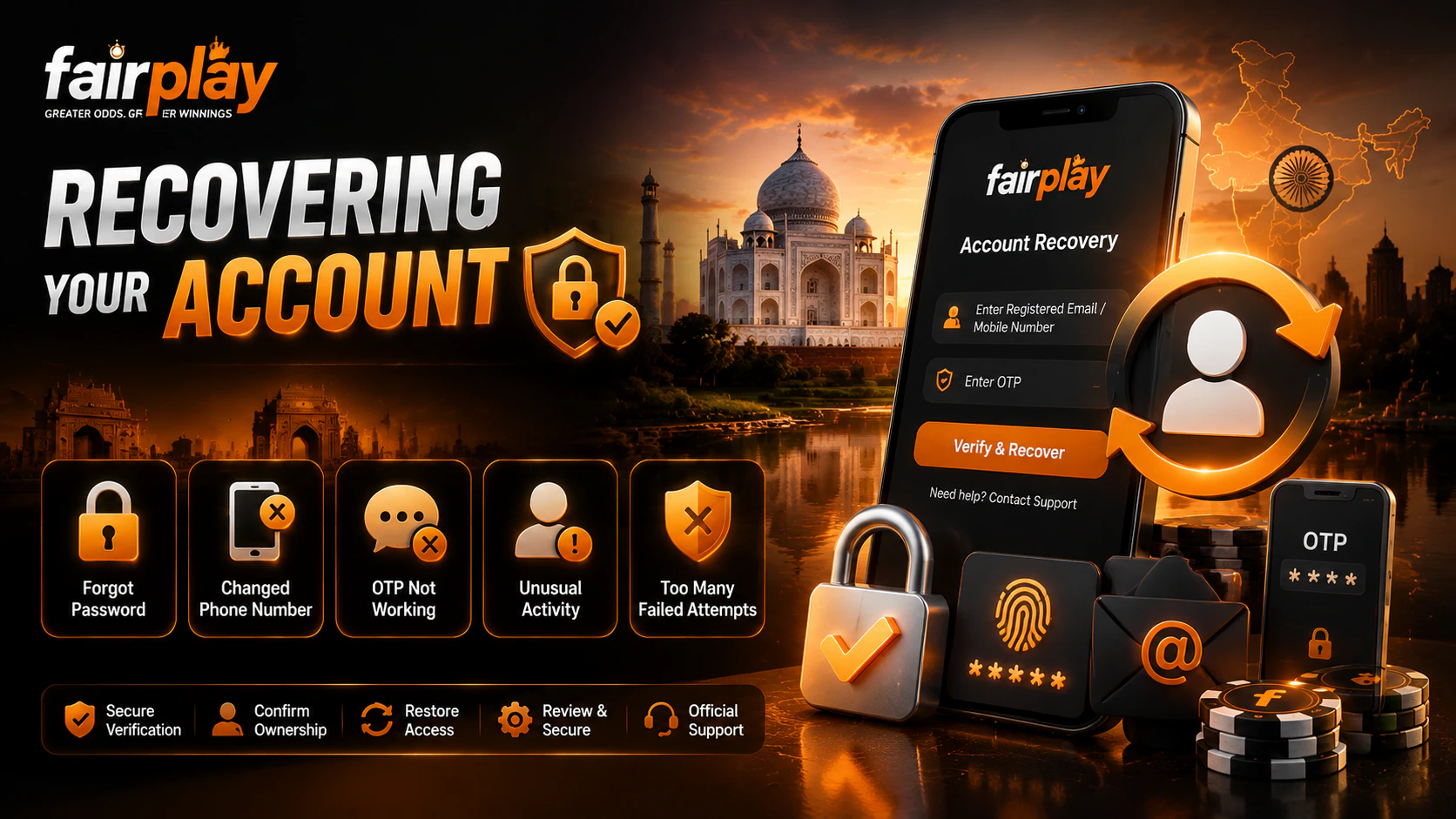
Recovery has two modes, and preparing for the first prevents the second. The standard mode assumes the registered phone or email still answers: from the login form, choose the recovery option, identify by phone or email, approve the arriving code or link, and create a replacement password — fresh, never used elsewhere, straight into the manager. Minutes, start to finish, and worth rehearsing once on a calm day just to know the screens.
The hard mode begins when the registered contacts are gone — a lost SIM, an abandoned inbox — and routes through official support with proof: account details, history, transactions where applicable. The friction is intentional; it is the same wall that stops a stranger claiming your account. Separate from both modes is the compromise scenario, where login still works but something is wrong — bets you did not place, settings changed, alerts about logins from elsewhere. The response order is fixed and fast:
- Change the password first, before anything else
- Terminate every other session where the settings allow
- Review OTP and notification settings for tampering
- Only then investigate what happened — containment before forensics An account secured within minutes of suspicion is an incident report; the same account watched “to be sure” for a week is a loss report.
Protecting Against Phishing and Fake Sites
Clones are this brand’s shadow industry, fed by its rotating domains and multiple names, and the defence is a reading habit rather than a technology. The genuine page and the counterfeit differ in exactly one reliable place — the address — so that is where the check lives:
- Read the domain letter by letter before the keyboard touches anything; the trick is always one character wide
- Confirm the secure connection and that the certificate matches the address shown
- Arrive by typed address or your own bookmark; ads, search shortcuts, and forwarded links are the clone’s delivery routes
- Treat messenger announcements of “new official domains” as hostile until the official site itself confirms them — WhatsApp and Telegram forwards are the dominant local channel for fakes
- Glance at the footer: licence details live there on the genuine site, and their absence on a login page is a siren
Suspicious chats deserve their own line. A “manager” offering to log you in, a “support agent” requesting your OTP to “verify the account,” a group sharing a working mirror — each is the attack itself, not a service around it. The genuine platform needs none of those interactions to let you in. When any doubt about a page exists, the resolution is mechanical: leave, return through your verified bookmark, and log in there. Doubt plus credentials is the one combination with no safe outcome.
Two-Factor Authentication Setup
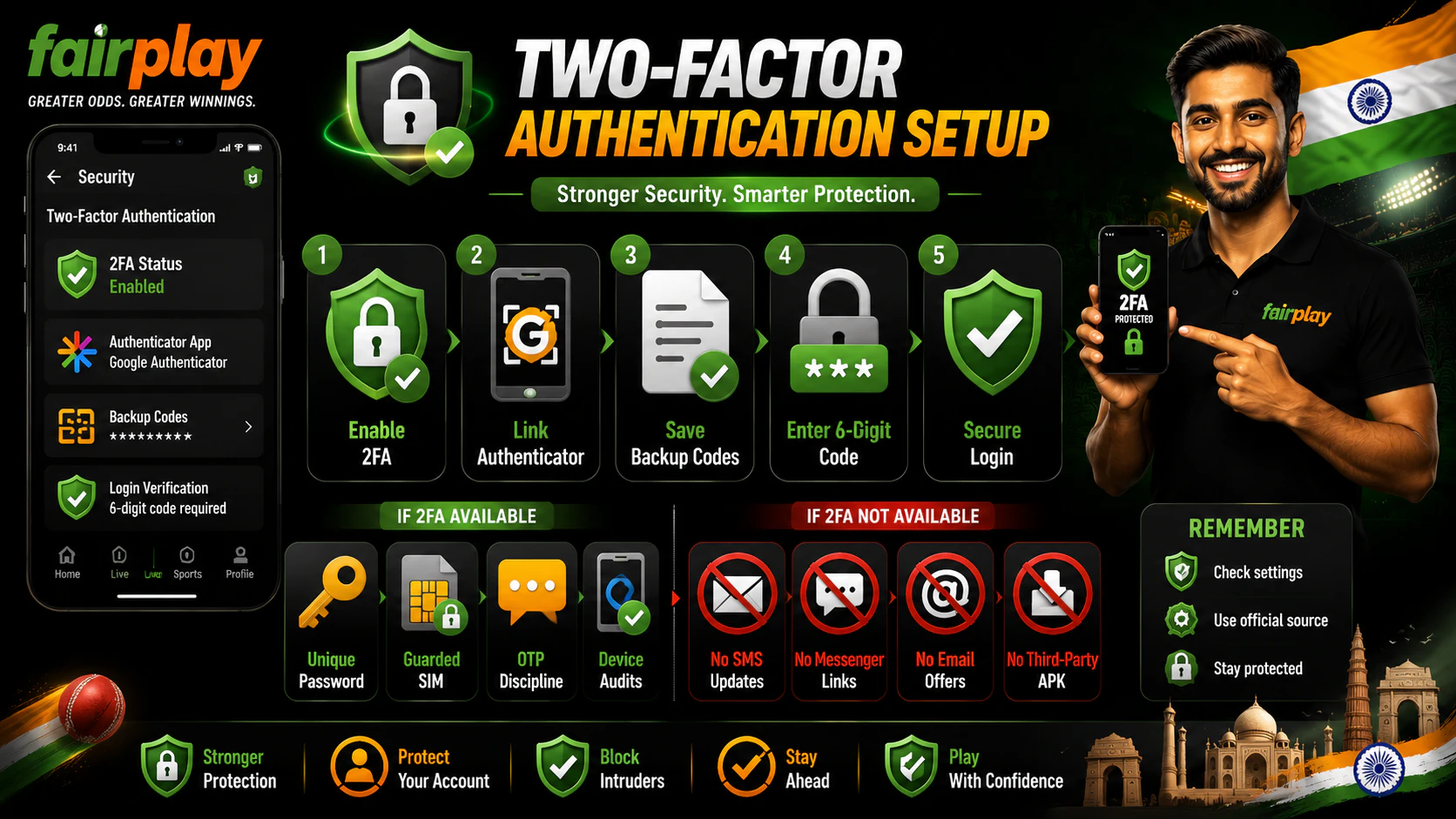
Two-factor authentication turns a stolen password into a failed attempt, which makes it the single highest-value setting an account can have. On this platform the honest status is conditional: a built-in 2FA option, typically through Google Authenticator, appears on some versions of the platform and is absent on others. So the working instruction is a check, then a choice. Open the security settings and look. Where 2FA is offered: enable it, link the authenticator Fairplay app, store the backup codes offline — paper in a drawer beats a note in the cloud — and accept the six-digit ritual at login as cheap insurance. Where it is absent: the compensating controls carry the load, applied without exceptions — the unique password, the guarded SIM, OTP discipline, and the device audits below.
One rule is universal across both cases, and it is the sentence worth memorising from this entire page: no legitimate person or process ever needs you to tell them a code. Codes are typed into pages you navigated to yourself; spoken, forwarded, or messaged codes have exactly one audience, and it is not support.
Monitoring Linked Devices
The device and session list is the account’s security camera, and most users never press play. Where the platform shows it — in the security or settings area — the list names the devices and sessions currently holding access: this phone, the browser from last month, possibly entries you cannot place. The monthly routine takes three minutes: open the list, match each entry against your real devices, and terminate everything unmatched — the sold phone, the borrowed laptop, the session from a city you have not visited. Removing a stale session costs nothing even when it was innocent; leaving a hostile one costs everything while looking like nothing.
The list also serves as an alarm. An entry appearing that you did not create means someone has, or had, your credentials — and the response escalates past mere session cleanup: change the password immediately, end all other sessions, review the OTP and notification settings, and watch the account closely for the following days. Login alerts, where the platform offers them, automate the alarm — a notification at each new sign-in turns the monthly audit into a real-time one, and the few seconds each alert costs are the cheapest monitoring a betting account can buy.